Borderline Personality
Disorder

1. Personality
Personality can be defined as the enduring patterns of inner experience and behavior that determine how a person perceives, relates to, and thinks about the world and themselves.
- It represents the “style” of being, shaped by genetics, early attachments, and life experiences.
- When flexible, personality provides resilience; when rigid and maladaptive, it leads to personality disorders.
Personality is not an “illness” but a configuration of traits, existing along a spectrum from adaptive to pathological.
Types of Personality Disorders (DSM-5)
- Cluster A (odd, eccentric): Paranoid, Schizoid, Schizotypal.
- Cluster B (dramatic, emotional, erratic): Antisocial, Borderline, Histrionic, Narcissistic.
- Cluster C (anxious, fearful): Avoidant, Dependent, Obsessive-Compulsive.
Borderline Personality Disorder lies at the heart of Cluster B, often seen as its most complex and enigmatic form.
2. Borderline Personality – An Enigmatic Condition
Historical Origins
- The term “borderline” was first used by Adolf Stern (1938) to describe patients who seemed to hover between neurosis and psychosis—“on the border.”
- Later, Otto Kernberg (1967) developed the concept of borderline personality organization, emphasizing identity diffusion, primitive defenses, and unstable reality testing.
- DSM-III (1980) formally recognized BPD as a distinct disorder.
3. Philosophical Interest
- BPD is often described as a disorder of identity and boundaries: “Who am I?” and “Can I trust you?” are its central questions.
- It reflects the fragility of the human condition: the thin line between love and hate, trust and betrayal, normality and madness.
4. The Mysterious Nature of BPD
- Chameleon-like: Patients may change emotional states and identities rapidly.
- Intense yet unstable relationships: A desperate need for closeness coexists with fear of abandonment.
- Mystery to psychiatry: Neither fully psychotic nor simply neurotic, BPD embodies psychic instability that resists rigid classification.
- Cultural fascination: Literature and cinema frequently depict characters with borderline traits—torn between extremes of passion and despair.
5. Core Symptoms (DSM-5 & ICD-11)
- Fear of abandonment – frantic efforts to avoid real/imagined rejection.
- Unstable relationships – swinging between idealization and devaluation.
- Identity disturbance – unstable self-image, sense of self.
- Impulsivity – risky behaviors (spending, sex, substance use, reckless driving).
- Affective instability – marked mood reactivity, intense episodic dysphoria, irritability, anxiety.
- Chronic emptiness – pervasive feelings of void.
- Inappropriate anger – difficulty controlling temper.
- Transient stress-related paranoia/dissociation.
- Self-harm/suicidal behavior – recurrent, often in response to rejection.
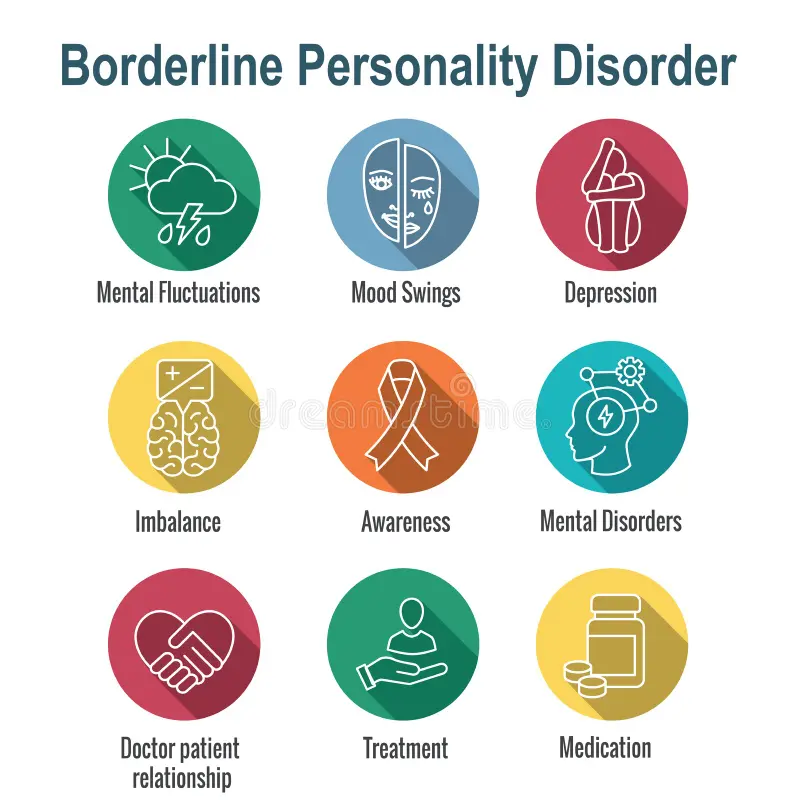
6. Natural History of Disorder
- Onset: Adolescence to early adulthood.
- Course: Intense symptoms (self-harm, impulsivity) often peak in young adulthood, with gradual reduction in later life.
- Remission: Many achieve functional stability by their 40s, though emotional sensitivity often persists.
- Prognosis: Better with supportive therapy, stable relationships, absence of comorbid substance misuse.
7. The Border with Normality
- Emotional intensity, sensitivity to rejection, and relationship difficulties are common human traits.
- In BPD, these traits are extreme, inflexible, and cause impairment.
- The “borderline” quality reflects the continuum between normal suffering and pathological intensity—a reminder that pathology is often an exaggeration of normal human struggles.
8. Treatment Approaches
a) Psychotherapy – The Cornerstone
- Dialectical Behavior Therapy (DBT – Marsha Linehan): Mindfulness, distress tolerance, emotional regulation, interpersonal effectiveness.
- Mentalization-Based Therapy (MBT – Bateman & Fonagy): Helps patients understand their own and others’ mental states.
- Schema Therapy (Young): Focuses on maladaptive schemas and reparenting.
- Transference-Focused Psychotherapy (Kernberg): Explores splitting and identity integration.
b) Pharmacotherapy
- No drug “cures” BPD.
- Symptom-based approach:
- SSRIs for affective instability.
- Mood stabilizers for impulsivity.
- Low-dose atypical antipsychotics for transient psychosis.
- Caution: High risk of polypharmacy and overdose.
c) Other Approaches
- Crisis planning and structured care.
- Family psychoeducation to reduce expressed emotions.
- Social rehabilitation – occupational and vocational support.
9. Challenges in Management
- Therapeutic alliance – patients may idealize/devalue therapists.
- Risk of burnout in clinicians due to intense emotional demands.
- Self-harm and suicidality – frequent, unpredictable, requiring vigilance.
- Comorbidities – depression, substance misuse, eating disorders.
- Stigma – often labeled as “difficult patients,” which can harm care.
10. Philosophical & Psychiatric Reflections
- BPD is not just an illness. Its a dramatization of human vulnerability: the yearning for love, the terror of abandonment, the instability of identity.
- It represents a border zone: between sanity and madness, passion and destruction, self and other.
- Understanding BPD requires empathy and humility seeing the disorder not as “difficult,” but as a cry of a fragmented self seeking coherence.
In summary:
Borderline Personality Disorder is a complex interplay of unstable identity, intense emotions, and chaotic relationships. Its natural history shows hope for remission, though challenges in treatment remain. At the frontier of psychiatry and philosophy, BPD compels us to reflect on the fragility of human attachment and the blurred boundary between normality and pathology.
Give Your feedback: