The Bystander Effect & Crowd Psychology
Introduction & Core Concept: The Paradox of the Collective
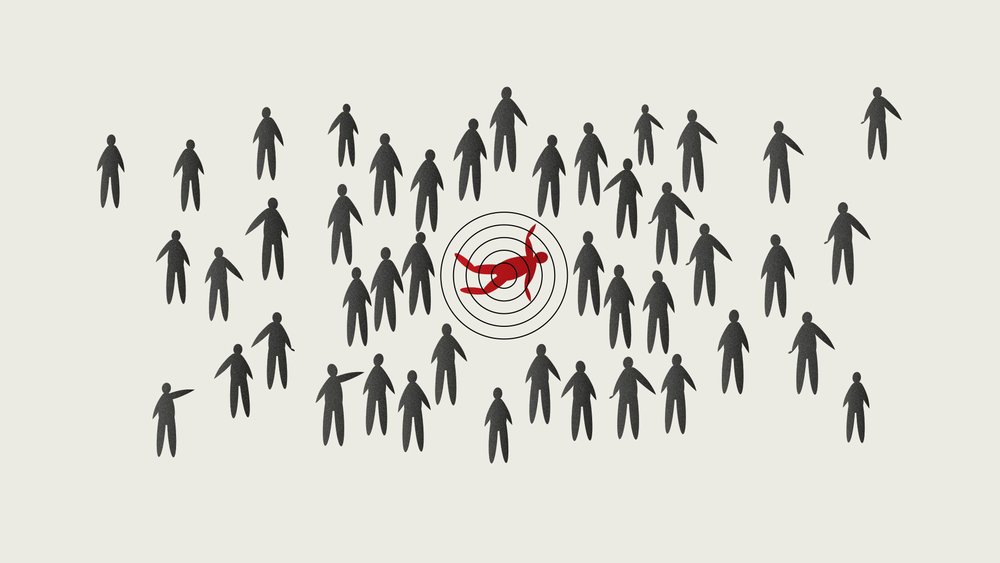
The bystander effect presents a profound and counterintuitive paradox of human nature, our instinct to help a person in distress often diminishes in the presence of others. It is a silent, social calculus where the probability of intervention is inversely proportional to the number of potential helpers. We find a perverse safety in the crowd, not from the threat itself, but from the burden of personal responsibility. This specific phenomenon is a single, stark thread in the vast and intricate tapestry of crowd psychology, the study of how our individual consciousness, moral compass, and identity can be subsumed by a emergent collective mind, an entity with its own emotions, norms, and momentum.
Historical Context & Etymology: From Parisian Theory to a Queens Street
- Bystander: From the simple English “by,” meaning “near,” and “stander,” meaning “one who stands.” It evokes a figure of passive observation, a witness who remains on the periphery of action.
- Effect: From Latin effectus, meaning “accomplishment” or “performance.” Here, it is the performance of a startling non-accomplishment.
The modern empirical study of the effect was catalyzed by the tragic 1964 murder of Kitty Genovese in Queens, New York. While initial reports of thirty-eight passive witnesses were later debunked as exaggeration, the narrative struck a deep cultural nerve. It became a modern parable, a dark mirror held up to urban society, questioning the very fabric of communal bonds. This event propelled psychologists Bibb Latané and John Darley to move beyond moral outrage and into the laboratory, seeking the hidden mechanisms of this seemingly inhuman inaction.
The roots of crowd psychology, however, run deeper. In the wake of the French Revolution’s fervent mobs, Gustave Le Bon, in his 1895 masterpiece The Crowd: A Study of the Popular Mind, argued that in a crowd, the “conscious personality vanishes,” and the individual is “absorbed by the unconscious.” He described a psychological law of mental unity, where the intellectual plane of the group sinks, governed by contagion and a thirst for illusion. Sigmund Freud later refined this, suggesting the crowd allows the individual to shed the burdens of their superego and hand it to a leader figure, unleashing primal instincts under the banner of the collective.
Detailed Exposition: The Cognitive Chain of Inaction
Latané and Darley decoded the pathology of inaction into a five-step cognitive chain. For help to occur, every link must hold. The presence of a crowd, however, expertly severs them.
- Notice the Event: In the cacophony of modern life, our attention is a scarce resource. A cry for help must compete with the glow of a smartphone, the rumble of a train, the internal monologue of our own worries. The signal must pierce the noise of our daily preoccupations.
- Interpret the Event as an Emergency: This is the heart of the crisis. Human situations are shrouded in ambiguity. Is that person staggering because they are having a stroke, or are they simply intoxicated? In this moment of uncertainty, we engage in a silent, desperate ballet of social proof, a process known as pluralistic ignorance. We discreetly scan the faces of others to calibrate our own reaction. If everyone else appears calm and unruffled, their passivity becomes our cue. The unspoken consensus forms: This is not an emergency. Our innate fear of appearing foolish is assuaged by the collective inertia.
- Example: Imagine an office worker suddenly slumping at their desk. A colleague glances over, sees the still form, but also sees others working diligently, undisturbed. The thought forms: “If it were serious, someone would have said something by now.” The silence of the many instructs the one to be silent.
- Assume Responsibility: Even if the event is recognized as dire, the individual must feel personally compelled to act. This is where diffusion of responsibility In a group, the moral burden is fractured and distributed among every witness. The weight on any single soul becomes feather-light. The internal monologue shifts from “I must do something” to “Surely, someone else is more qualified,” or “The person closer to them will help.” It is the dilution of duty in the vast ocean of the crowd.
- Know How to Help: Compassion requires competence. A bystander may feel the urge to intervene but be paralyzed by the fear of doing harm, of not knowing CPR, of misusing a defibrillator.
- Decide to Implement the Help: The final barrier is a cost-benefit analysis: “Will I be in danger?” “Will I be late for my important meeting?” “What if I’m wrong and embarrass myself?”
A Vignette of Vanished Responsibility
The Subway Car: A Cathedral of Apathy
The air is close, laced with the metallic scent of the tunnels. A man in a neat suit, perhaps in his fifties, grips a pole. His knuckles whiten. A low groan escapes his lips as he slides down the pole, collapsing onto the grimy floor, his body seizing.
For a moment, there is a freeze-frame of horror. Dozens of eyes widen. Then, the psychological script of the bystander effect begins, written in glances and hesitations.
- Pluralistic Ignorance: A woman looks from the seizing man to the businessman next to her, who has already buried his nose back in his newspaper. His lack of alarm is her data point. A student meets the eyes of another passenger; they share a look of confusion, not concern, and both quickly look away. The unspoken consensus solidifies: This is not my problem to define.
- Diffusion of Responsibility: The woman thinks, “The man in the uniform by the door, he’s probably transit police.” The student assumes, “That nurse-looking woman is already pulling out her phone.” The nurse-looking woman thinks, “Surely someone has already pressed the emergency intercom.” Each person becomes a single note in a symphony of inaction, believing they are merely the audience.
The train clatters on toward the next stop, a sealed capsule of shared, unacknowledged crisis. It is only when one person often someone with specific training, or who has experienced a similar event, breaks the spell by shouting “I need a doctor!” and pointing to a specific individual, “You, call 911 now!” that the diffusion reverses. Responsibility is suddenly, forcefully, concentrated onto a single person, and the chain of aid can begin.
Clinical Relevance: This understanding is not academic; it is a lifesaving tool.
- Training: Modern first-aid and crisis response training explicitly teaches people to be a vocal minority. They are drilled to single individuals out of the crowd (“You in the blue jacket!”) and give direct commands (“Call 911 and tell me when it’s done!”). This shatters pluralistic ignorance and annihilates diffusion of responsibility.
- Therapeutic Context: Survivors of public trauma where no one helped often suffer from profound existential anguish “Why did no one care?” which can exacerbate PTSD. Understanding the bystander effect as a predictable psychological failure, not a personal moral indictment of them or humanity, can be a crucial part of cognitive restructuring in therapy.
Theorist's Contribution: The Architects of Understanding
Latané and Darley were the cartographers of this strange territory of the human soul. They took a moment of profound urban mythos and subjected it to the rigorous light of science. Through elegant experiments (like the famous “smoke-filled room” study), they demonstrated that failure to help was not a “collapse of character” but rather the default setting of group dynamics.
They challenged the narrative of the “apathetic citizen” and revealed instead a universal human vulnerability to social context. Their great contribution was to show that the price of our social nature, our deep need to look to others for cues on how to behave is that sometimes, tragically, we all look to each other at once, and all see the same thing, a reflection of their own hesitation.
References
- Darley, J. M., & Latané, B. (1968). Bystander intervention in emergencies: Diffusion of responsibility. Journal of Personality and Social Psychology, 8(4, Pt.1), 377–383. https://doi.org/10.1037/h0025589
- Latané, B., & Darley, J. M. (1970). The unresponsive bystander: Why doesn’t he help? Appleton-Century-Crofts.
- Le Bon, G. (1895/2002). The crowd: A study of the popular mind. Dover Publications.